


One page says Dekton countertops shrug off anything a kitchen can throw at them. A forum thread says the edges chip. Buyers read both and are left unsure what to trust.
The answer depends on how you cook, where the counter sits, and who cuts and fits it. Below we cover what Dekton is. We cover where it leads and where it costs you. We compare it with engineered quartz, Silestone, and granite. We also cover the part most countertop guides skip. Your appliances set the size of the holes in the slab. So they belong in the plan before anyone templates it.
Is Dekton a good countertop?
Dekton is a good countertop for the right kitchen. Pick it when you want more room for error with heat. Pick it when the counter takes strong sun or sits outdoors. It soaks up almost no liquid, and it wears well. You also need a fabricator with recent Dekton work. A fabricator is the shop that cuts the slab and fits it in your kitchen. The trade-off sits at the edges. Exposed edges and cutout corners stay impact sensitive.
Buy it if your counter runs through direct sun, lives in an outdoor kitchen, or needs more heat margin. Then follow the current care guide for the thickness you pick.
Skip it if you want the easier project. Skip it if you want a repair path more shops know, natural slab variation, or a lower quote. Standard quartz or granite may already cover how you cook.
What is Dekton?
Cosentino Dekton is a sintered mineral surface. Sintered means the minerals are pressed and heated until they fuse into one solid sheet. It is not engineered quartz, and it is not natural stone. That is why it behaves like neither. Cosentino’s Dekton material page is the starting point for colors and current documents.
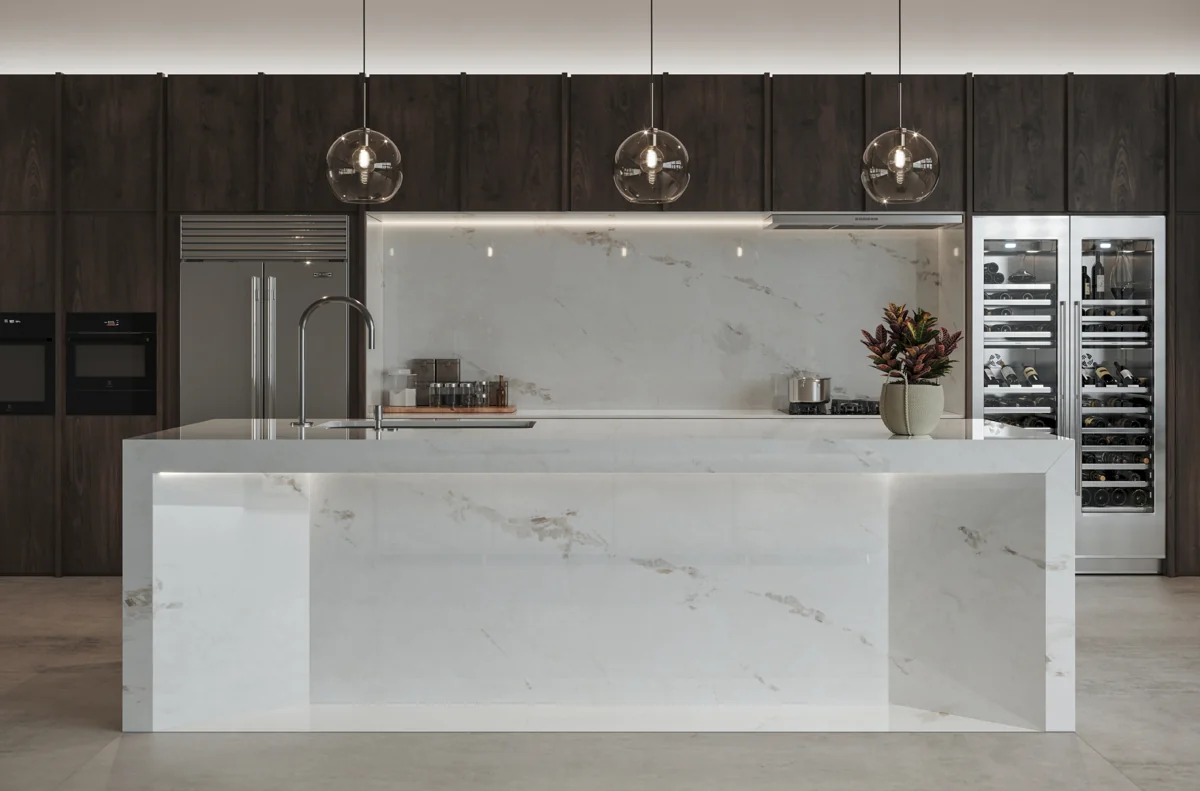
The recipe matters more than it sounds. Cosentino’s environmental product declaration calls Dekton fully inorganic. It is made without resins or organic additives. The same document says the material comes from high-temperature sintering of ultracompacted minerals. The proportions change by color. Cosentino calls its process Particle Sintering Technology. That resin-free makeup sets Dekton apart from engineered quartz. Quartz makers still advise protection from sustained heat. Do not assume a conventional indoor quartz is fit for strong sun or outdoor use.
Cosentino’s current catalog lists five thicknesses: 4, 8, 12, 20, and 30 mm. Check availability on the 4 mm and 30 mm options. The 4 mm is a cladding thickness, not a structural countertop. The May 2026 catalog gives nominal slabs of 126 by 56 inches. Jumbo slabs are 130 by 64 inches. Treat those as nominal, meaning a stated size and not a promise. Cosentino’s installation manual says slab format changes by color and thickness. It tells designers to check original dimensions for the material they picked. Large slabs reduce seams. They do not promise a kitchen without any.
Dekton, Silestone, and quartz differ
Cosentino makes both Dekton and Silestone. They are separate material systems. Silestone is Cosentino’s engineered mineral surface. For a buying decision, treat it as a brand choice inside the quartz family. It is not natural stone, and it is not a fourth category.
Each product carries its own guidance. Cosentino’s advice on trivets and outdoor use is different for Silestone than for Dekton. Calling Silestone just quartz hides differences that change care and placement.
How we compared these countertops
We built this comparison from Cosentino’s own technical, care, installation, and warranty documents. We also used independent consumer testing and natural-stone trade guidance. We read appliance installation manuals. And we used the questions our customers ask in the showroom.
Two limits are worth stating once, here, so the rest of the guide can stay readable. First, no independent head-to-head test proves Dekton beats quartz or granite. Cosentino’s performance data is standardized lab testing on its own material. So we attribute those claims to Cosentino. We do not present them as settled fact. Second, owner and forum reports tell us what buyers worry about. They do not measure how often anything fails, and we do not treat them as a failure rate.
Inspect a physical slab before you commit. A sample that represents the slab also works. Look at it under your project’s lighting. Photos, chip samples, patterns, and current availability all differ. Cosentino’s warranty excludes appearance differences between samples or photographs and the slab you receive.
Dekton countertop benefits
Heat is the first one, and it is the one people feel every day. Cosentino says frying pans, saucepans, casseroles, and coffee makers can be set directly on the work surface after use. Two caveats travel with that. On 8 mm Dekton, Cosentino requires protection against hot objects. The care manual also says to keep direct flame off the surface. Keep hot metal parts of an incorrectly installed cooktop, boiler, or oven from touching it.
Sun and weather are a strong use case for Dekton. Cosentino designs it for indoor and outdoor use. It documents UV and weather resistance. UV is the part of sunlight that fades and damages many surfaces over time. Most conventional quartz is an indoor product. Cosentino says plainly that Silestone is not recommended outdoors, because UV can damage the surface. Dekton deserves a closer look for an outdoor kitchen, a sunroom, or a counter in hard afternoon light.
Porosity is close to zero, so there is no annual sealing step. Porosity means how much liquid a surface soaks up. Daily care is water and neutral soap. Cosentino’s Q-Action cleaner with a soft-fiber sponge also works. Cosentino’s EN 14411 family test data reported 0.1 percent water absorption under vacuum. It reported no damage in the cited thermal-shock test. It reported top-class results on the listed iodine and olive oil staining tests. That data is from 2016 and covers named legacy color families. Read it as evidence about the category, not as a spec sheet for the color you choose.
The surface holds up to daily abuse. In 2015, Consumer Reports rated Dekton excellent against heat, stains, chopping, and cutting. It rated Dekton one grade below that against abrasion. Cosentino markets it as highly scratch resistant. We would still keep a cutting board on the counter, both for your knives and for the finish.
Large slabs and thin profiles open up more design options. Matte, gloss, velvet, and textured finishes also read differently in person than they do on a screen.
Dekton countertop drawbacks
The main disadvantages sit at the edges, not on the open field of the counter. Exposed edges and cutout corners can chip under a sharp knock. A crack is usually not a repair that lasts. Fabrication is specialist work with strict support and radius rules. The finished project often runs above a standard quartz job.
Surface scratch resistance is not the same as impact toughness. A counter can resist knife marks and still chip where a heavy pot catches a corner. Cosentino calls the surface highly resistant. Its care manual still tells owners to avoid knocks at corners, edges, and bevels.
The independent evidence points the same way, with a caveat. Consumer Reports’ 2015 samples chipped at the edges and cracked during impact testing. Cosentino responded that the test conditions did not follow its installation guidance. Both parts belong in your decision. It is real evidence that edges are the weak point. It is not a measure of how often a current, correctly installed Dekton counter fails.
Repair is where this gets practical. Cosentino says a professional can usually repair a small edge chip. It says cracks generally keep growing, so a crack repair tends to be short-lived. The warranty draws the line in the same place. Cracking and chipping caused by impact from a heavy object is excluded. So is cracking and chipping caused by movement or displacement of the supporting structure.
Fabrication is the other cost you cannot see in a slab price. Cosentino wants the work done in a shop. It calls for water-fed cutting and approved tooling. It calls for minimum radii at openings, shaped edges, and reinforcement where it is needed. The slab needs continuous level support underneath. Improper fabrication and installation are warranty exclusions. Even when Cosentino supplies replacement material, the cost of preparing and installing it is not covered. The fabricator you choose is part of the product.
On money, Dekton often lands above standard quartz and common granite projects. That is once you count specialist fabrication, cutouts, edge details, and support. We avoid an absolute price-rank claim here, because installed quotes overlap widely across all four materials.
Last, the feel. Some buyers find Dekton harder and cooler underhand than resin-bound quartz. That is a preference, not a fault. Touch a finished edge before you commit.
Where chips happen and what repair looks like
Cosentino points to two places where accidental chips show up: the sink area under the surface, and the dishwasher zone. Both make sense once you picture a wet pan swinging toward an exposed edge.
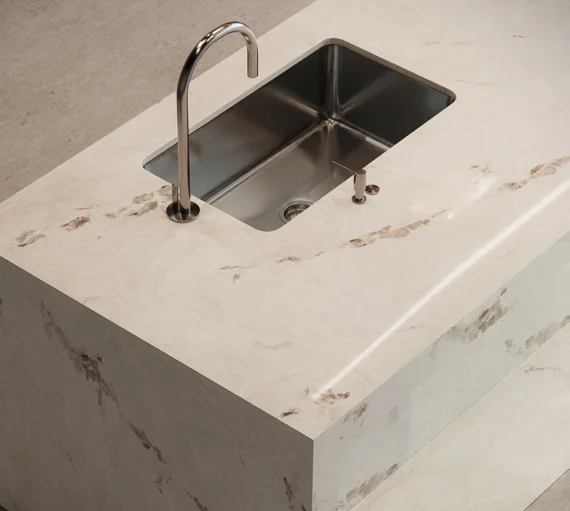
Edge geometry is a decision, not a detail. Cosentino recommends shaping exposed edges to improve impact resistance. Its manual gives the profiles by thickness. Ask your fabricator how they plan to shape and reinforce exposed edges, sink edges, and cutout corners. Ask them to show you a finished sample.
Support belongs in the same conversation. The countertop has to rest completely on a level, strong cabinet structure. Movement of that structure is an excluded warranty cause. That tells you how much Cosentino thinks it matters.
A qualified stone professional can usually repair a small edge chip in a working area. Cracks are the harder case, because Cosentino says they generally continue to grow. Patterned and veined finishes make any repair easier to see. The fill has to match a moving pattern instead of a flat color.
Settle the service path before you sign. Ask who performs repairs after installation. Ask how color matching works on your chosen finish. Ask what a replacement would involve in your kitchen.
Dekton vs quartz and Silestone
There is no single winner in dekton vs quartz. The better fit depends on the room, how you cook, and the fabricator. Here is how the four materials compare.
| What matters | Dekton | Engineered quartz | Silestone | Granite |
|---|---|---|---|---|
| Material identity | Cosentino sintered mineral surface, not quartz and not stone | Mineral particles bound with resin and pigment, formulas vary by brand | Cosentino engineered mineral surface inside the quartz family | Quarried natural stone, every slab is different |
| Everyday heat | Cosentino permits routine hot cookware, with thickness, flame, and installation caveats | Fine in daily use, trivets recommended to protect the resin | Heat resistant in ordinary use, Cosentino recommends trivets | Scored strongly in independent heat testing, trivets still prudent |
| Sun and outdoor use | Cosentino rates Dekton for indoor and outdoor exposure | Most conventional quartz is indoor only, verify the exact product | Cosentino says it is not recommended outdoors | Widely used outdoors, confirm stone, finish, and climate with the supplier |
| Sealing and stains | Near-zero porosity, no routine sealing | Nonporous, no routine sealing | Low maintenance, no routine sealing, dilute bleach and rinse it off | Porosity varies, an impregnating sealer improves stain resistance |
| Scratches and abrasion | Strong in independent cutting and abrasion testing | Resists normal scratches, avoid abrasive cleaners | Built for normal wear, metal marks can show and often clean off | Top marks for scratch resistance, deeper marks need repolishing |
| Edge chips and cracks | The main caveat, edges and cutout corners are impact sensitive | Can chip or crack, small damage is often repairable | Can chip near sinks and dishwashers, cracks are the harder case | Can chip at edges, small damage is often filled |
| Repair options | Chips usually repairable, cracks usually not a lasting repair | Chips and cracks commonly filled with resin or epoxy | Chips usually repairable, cracks usually not | Chips and cracks often epoxy filled, deeper damage repolished |
| Fabrication complexity | Generally the most demanding here, with water-fed cutting, radii, reinforcement, and continuous support | Professional work, generally more forgiving on complex cuts | Professional fabrication following current Cosentino instructions | Professional template and fabrication, slab variation needs layout planning |
| Cost direction | Often above standard quartz and common granite once fabrication is counted | Broad range with many midrange choices | Varies by collection, thickness, and edge detail | Ranges from common stones to rare slabs |
Quartz and Silestone tend to make an indoor project simpler. Dekton gives you more heat and sun margin, and its fabrication rules are stricter.
Choose quartz or Silestone if
Your kitchen is indoors with no direct sun load on the counter. You want a broad design selection and a familiar fabrication market. You are happy using trivets. You want a chip repair path more shops know.
Silestone brings a strong branded palette and low maintenance. Cosentino’s guidance is to use trivets and keep it indoors. Dilute bleach and rinse it off instead of letting it sit.
Choose Dekton if
You are building an outdoor kitchen, a sunroom counter, or a run that takes direct sun for hours. You cook hard, with hot cookware moving on and off the surface. You want the thin, large-format look and porosity close to zero.
One more condition carries as much weight as the rest. You need a fabricator with recent Dekton work who follows the current Cosentino manual. Ask to see a job they finished this year.
Dekton vs granite
Granite suits buyers who want a one-of-a-kind slab. It has natural crystalline depth and strong heat tolerance. Many stone professionals already know how to repair it. If the material itself is part of the design story, granite offers variation that manufactured patterns do not reproduce exactly.
What makes it different is also what makes it work: no two slabs match. That turns slab selection into a real design decision. Go see the actual slab, not a four-inch sample. The piece on the rack is the piece in your kitchen.
The honest trade-off is care. Sealing needs vary by stone. The Natural Stone Institute says many stones may not require sealing. It says an impregnating sealer improves stain resistance. A sealer does not make stone immune to stains. Your supplier should tell you what your slab needs. In Consumer Reports testing, granite scored strongly for stain, heat, and scratch resistance. So this is about upkeep, not durability.
Dekton suits a different priority. You want a more controlled manufactured design than one-of-a-kind granite. You want almost no porosity and no sealing decision to make. Pattern, shade, and slab matching still need full-slab review.
Buyers often ask whether Dekton is more expensive than granite. No fixed ranking holds. Both ranges are wide, and installed quotes overlap. Compare the two projects, not the two labels.
What drives Dekton countertops price
We do not publish one Dekton countertop price per square foot. It would not describe your installed project. Published square-foot figures may omit fabrication and variables unique to the job. A national average cannot account for your kitchen.
Here is what actually moves the number:
- Collection and color affect slab cost and availability.
- Slab yield covers how much of each slab the layout uses and how much becomes offcut.
- Thickness affects whether the design needs a built-up or mitered edge.
- Edge profiles, waterfalls, and miter details add work.
- Sink and cooktop cutouts need the right radii and reinforcement.
- Seam count and placement affect labor and slab use.
- Heavy sinks, cooktops, and overhangs may need more support.
- Stairs, tight turns, and long carries can raise site costs.
- Fabricator experience with Dekton matters.
A Dekton project often lands above a standard quartz job and above common granite once specialist fabrication is included. Installed quotes still overlap widely. Compare like-for-like installed quotes on your own layout instead of slab prices.
Lock your appliances before templating
This is a rule we repeat in the showroom. Choose your exact appliance models. Read each current installation guide before the countertop template is approved. A template is the full-size pattern the fabricator uses to cut your slab. Changing a cooktop after the slab is cut can force an expensive countertop remake.
Nominal appliance width does not define the cutout. Overall dimensions and required cutout dimensions are two different numbers, and both change by model. Bosch, to take one example, publishes them separately for each cooktop. It attaches the installation instructions. Never size an opening from a 30-inch or 36-inch label.
Induction shows why this matters. Fisher & Paykel installation guides call for an adequate supply of cool air. They publish ventilation gaps, or alternative vent openings, that change by model. So the cabinet and countertop plan has to account for more than the visible glass. Flush-mounted cooktops can need a recessed second cut beyond the chassis opening. If you are still weighing induction against gas, our induction cooktop guide covers the appliance side of that choice.
Ranges and rangetops bring their own list. Wolf installation guidance calls for a finished opening and a level support platform. It also calls for utility cutouts and clearances. Both change by model and setup. Whirlpool notes that some slide-in range sides overlap the countertop cutout edge. That is the kind of detail only a manual tells you.
Cosentino’s manual sets the material side of this. It requires a minimum 10 mm inside-corner radius on sink and cooktop cutouts. Other cutouts need at least 5 mm. Cutout edges must be slightly chamfered. Its illustrated under-mount configuration is allowed for glass-ceramic and induction cooktops. It is prohibited for gas, because flame must never project directly onto Dekton. Large or heavy sinks and cooktops need support bars. That means anything over 24 inches or unusually heavy. The bars anchor to the cabinets instead of loading the slab. For installation dimensions and for ventilation below the countertop, the manual defers to the appliance maker.
Cosentino’s cutout instructions do not cover appliance types beyond gas, glass-ceramic, and induction cooktops. Downdrafts, warming drawers, and invisible-induction systems need their own documents. They also need written fabricator approval. A heat-resistant countertop does not cancel an appliance’s clearance or ventilation rules. Those come from the appliance manual.
Cutting and grinding countertop material makes respirable silica dust. Respirable means fine enough to breathe deep into the lungs. The cited hazard concerns dust made during fabrication and alteration. It is not ordinary contact with an intact, installed countertop. Wet methods and other controls belong in a proper shop.
Your pre-template checklist
Take this list to your fabricator meeting.
- Confirm the sink, faucet, cooktop or range, ventilation, outlets, and mounting methods.
- Bring the current installation guide for each appliance model.
- Decide the edge profile and how the fabricator will shape exposed and sink edges.
- Review cutout radii, reinforcement, and seam positions against the current Cosentino manual.
- Confirm level cabinets, continuous support, and support bars under heavy sinks or cooktops.
- Check overhang, waterfall, and miter details against the right configuration table.
- Review recent Dekton work by the fabricator.
- Agree on who handles chip repairs and what the warranty covers.
- Inspect and approve a physical slab or a sample that represents it.
Dekton countertop care and warranty
Daily care is short, and there is no routine sealing. Cosentino’s current Dekton care guide recommends Q-Action with a soft-fiber sponge. Water and neutral soap work when that is not on hand. Rinse and dry, and the counter is done.
Stubborn stains have assigned treatments in Cosentino’s care table, sorted by what caused them. Coffee and wine call for an alkaline detergent or acid. Rubber calls for a degreaser. Candle wax and ink call for a solvent. Cola or fruit juice calls for an oxidant. Work from the current care guide instead of mixing something yourself.
A few cautions apply across finishes. Skip metal sponges and anything with abrasive particles. Keep hydrofluoric acid products off the surface entirely. Finish changes the rules. Gloss and textured Dekton carry extra precautions that a matte counter does not.
We get asked about disinfecting. Cosentino permits disinfectant and multipurpose cleaners. It prefers diluted products. It says undiluted disinfectant should not stay on the surface longer than five minutes, and it expects residue to be rinsed off.
The North American standard warranty terms we reviewed cover most registered residential Dekton installations. They give a limited 25-year manufacturing-defect warranty. GRIP and GRIP+ finishes are limited to five years. Registration is required within six months of purchase, and proof of purchase is required. The document says the warranty is transferable. Covered conditions include thermal-shock cracking and UV fading, subject to the terms. They also include ordinary food and household stains, where the care guidance was followed.
What is excluded tells you more than the headline number. Cracking and chipping from heavy-object impact is out. So is cracking and chipping from movement of the supporting structure. Improper fabrication or installation is out. Appearance differences from samples and photographs are out. Even when Cosentino provides replacement material, preparation and installation costs are not covered. Warranty language changes over time. Read the terms delivered with your purchase, not any summary, including this one.
The Artik Nodes collection
Artik Nodes is Cosentino’s May 2026 Dekton collection, and it runs three colors. Bering is a snowy white with stone-gray veins. Borealis is an ivory white with a faint pinkish cast and irregular sand-colored veins. Inuk is a glacier white with an even base and soft, diffuse veining. The Artik Nodes collection page carries the current catalog.
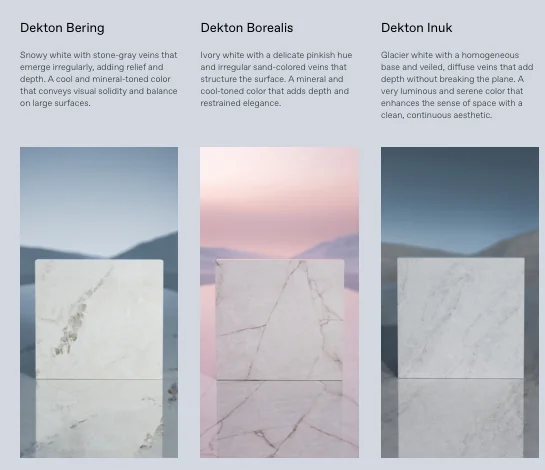
Cosentino describes the design as a reinterpretation of quartzite’s look. It is built around an Arctic ice-fracture motif, where veins meet at nodes. That is design language, and a good description of what the surface is going for. It is not a claim that the material is quartzite. It is not a claim that the veining runs through the body of the slab.
Do one thing before you order a white with movement. View a full slab, not a chip sample. Pattern and color vary from piece to piece. Differences between a sample and the slab you receive are excluded from the warranty.
Planning a Dekton project with Masters
Masters works with Cosentino, and exclusive Masters pricing is available by quote.
The practical value is in the order of the work. We sell the appliances, and we can coordinate the countertop. So cutouts, ventilation, support, and clearances get settled before templating, not after. When kitchens are planned in pieces, a late cooktop change can leave a finished opening that no longer fits. That can force a countertop remake.
Once you have reviewed the material and the appliance requirements, ask Masters for a coordinated countertop and appliance quote.
Frequently asked questions about Dekton countertops
What are the main disadvantages of Dekton countertops?
Exposed edges and cutout corners can chip under a sharp knock. Cracks usually cannot be repaired in a way that lasts. Fabrication is specialist work with strict support and radius rules. The installed price often runs above a standard quartz job. Some buyers also find the surface harder and cooler underhand than quartz.
Is Dekton better than quartz?
Neither one wins every kitchen. Dekton is a strong fit for direct sun, outdoor kitchens, and heavy cooking. It suits buyers who value heat and abrasion resistance. Quartz is often the more budget-flexible indoor choice, with a familiar fabrication market and more established chip-repair options.
Does Dekton chip, and can it be repaired?
The field of the counter is hard-wearing. Edges and cutout corners are the weak point, and independent 2015 impact testing found the same thing. Shaped edges, radiused cutouts, and level continuous support lower the risk. A qualified stone professional can usually repair a small edge chip. Cosentino says cracks generally keep growing, so a crack repair tends to be short-lived.
Can you put a hot pan directly on Dekton?
Cosentino says frying pans, saucepans, casseroles, and coffee makers can be set directly on the work surface after use. On 8 mm Dekton, use protection against hot objects. Keep direct flame off the surface. Keep hot metal parts of an incorrectly installed cooktop or oven from touching it.
Does Dekton need to be sealed?
No routine sealing. Porosity is close to zero, so there is no annual sealer step. Clean with Cosentino’s recommended cleaner and a soft-fiber sponge, or water and neutral soap. Rinse and dry the surface. Keep hydrofluoric acid products away from it.
Can I use disinfecting wipes or bleach on Dekton?
Cosentino permits disinfectant and multipurpose cleaners on Dekton. It prefers diluted products. It says undiluted disinfectant should not stay on the surface longer than five minutes, and it expects residue to be rinsed off. Follow the label on the cleaner you choose, and skip anything with hydrofluoric acid.
Is Dekton good for an outdoor kitchen?
Yes, and this is one of its main advantages. Cabinet structure, continuous support, freeze-and-thaw-aware installation, seam placement, and appliance clearances still govern the result. Do not substitute conventional quartz or Silestone outdoors unless that exact product is rated and warranted for it.
The decision rule
Dekton countertops earn their place on heat margin, UV stability, near-zero porosity, and abrasion resistance. They are a strong candidate for outdoor and sun-exposed kitchens. The trade-off is real. Exposed edges and cutout corners stay impact sensitive, and a crack is usually not a lasting repair.
Quartz, Silestone, and granite each win in some kitchens. So the right call comes down to the room, the cooking, and the fabricator you can get. Whatever surface you land on, lock the appliances first.