

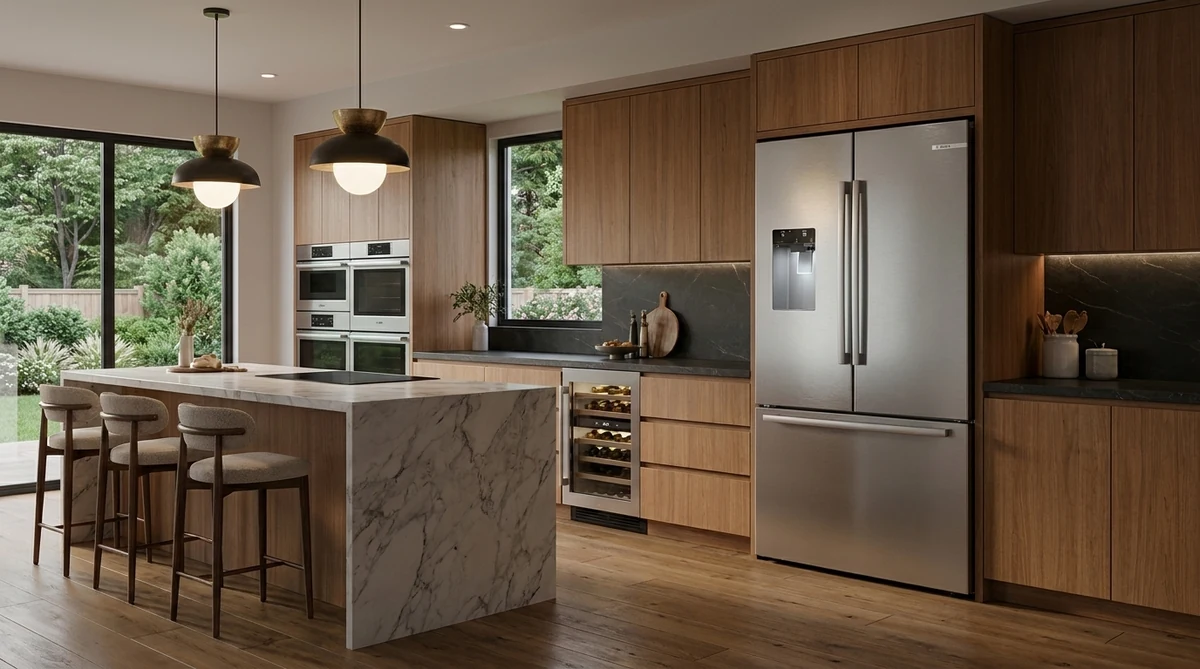
Counter-depth French door refrigerators from premium European brands rarely dip under $1,800. Right now the Bosch B36CD10ENS is sitting at exactly that, $1,000 below its $2,799 MSRP. That’s a price we almost never see on a Bosch counter-depth French door.
We’ll walk through what that $1,799 buys, how it stacks up against LG, Samsung, GE, Frigidaire, and KitchenAid, what owners praise and complain about, and who should act on this deal while it holds.
Quick verdict: is the Bosch B36CD10ENS worth it at $1,799?
Yes, for the right kitchen. At $1,799, the B36CD10ENS is the cheapest premium-brand counter-depth French door on the market right now, undercutting LG by $40, Samsung by $100, Frigidaire by $300, GE by $398, and KitchenAid by $700. Skip it if you need 25-plus cu ft, heavy daily water dispenser use, or fast warranty service in your region.
The $1,000 savings in context
MSRP is $2,799. The sale price is $1,799. That’s a $1,000 cut, or about 36% off.
Premium counter-depth French doors rarely clear the $2,000 floor. This one clears it by $200 and still lands below the mass-market alternatives we track. The counter-depth category averages around $2,500, so at MSRP this Bosch sits above the category mean. The $1,000 drop flips it to roughly 72% of what shoppers typically spend here. That’s the difference between paying a modest premium for the Bosch name and paying a discount for it.
The urgency here is simple: we aren’t running a fake countdown. At current pricing, no other premium-European brand touches this segment for less. Bosch does adjust promotional pricing through the year, and inventory on popular counter-depth SKUs moves fast when the number drops this low. If you’re newer to appliance sale cycles, our guide on when to buy appliances explains how pricing windows like this one typically behave. If the size and specs match your kitchen, waiting rarely pays off.
What $1,799 actually buys you
Capacity and dimensions
Total capacity is 21.6 cu ft, split as 15.2 cu ft in the fresh section and 6.4 cu ft in the pull-out freezer drawer. Ice storage holds 2.8 lbs.
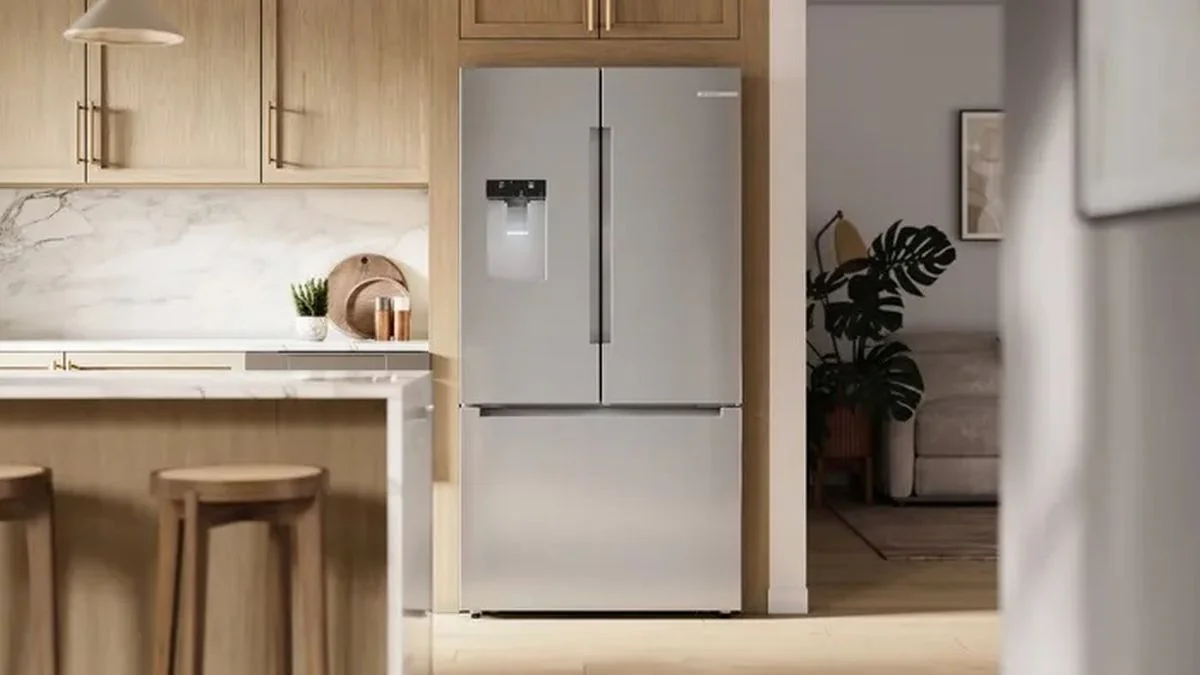
Footprint is 35.63″ wide, 70″ tall, and 27.81″ deep including the handles (25″ without). It fits a standard 36″ cutout and sits flush with counters for that built-in look. Doors swing out 43.38″ at 90 degrees, so measure your island clearance before buying. Height without the door hinge case is 69.5″, useful if you’re fitting under a soffit.
One practical note most product pages bury: delivery weight is 282 lbs. That matters for two reasons. Most installers will handle it as a two-person job, and if your path to the kitchen has tight turns, narrow doorways, or a staircase, flag it with delivery at booking. Counter-depth models are deceptively heavy because the compressor and insulation package sits closer to the cabinet depth without the extra profile of a standard fridge.
Ice, water, and cooling
The QuickIce Pro external ice maker pulls up to 8 lbs per day, which Bosch markets as the fastest in class. Ice and water come through the dispenser on the left door, including a BottleFill mode that lets you preset a fill volume and walk away while it fills.
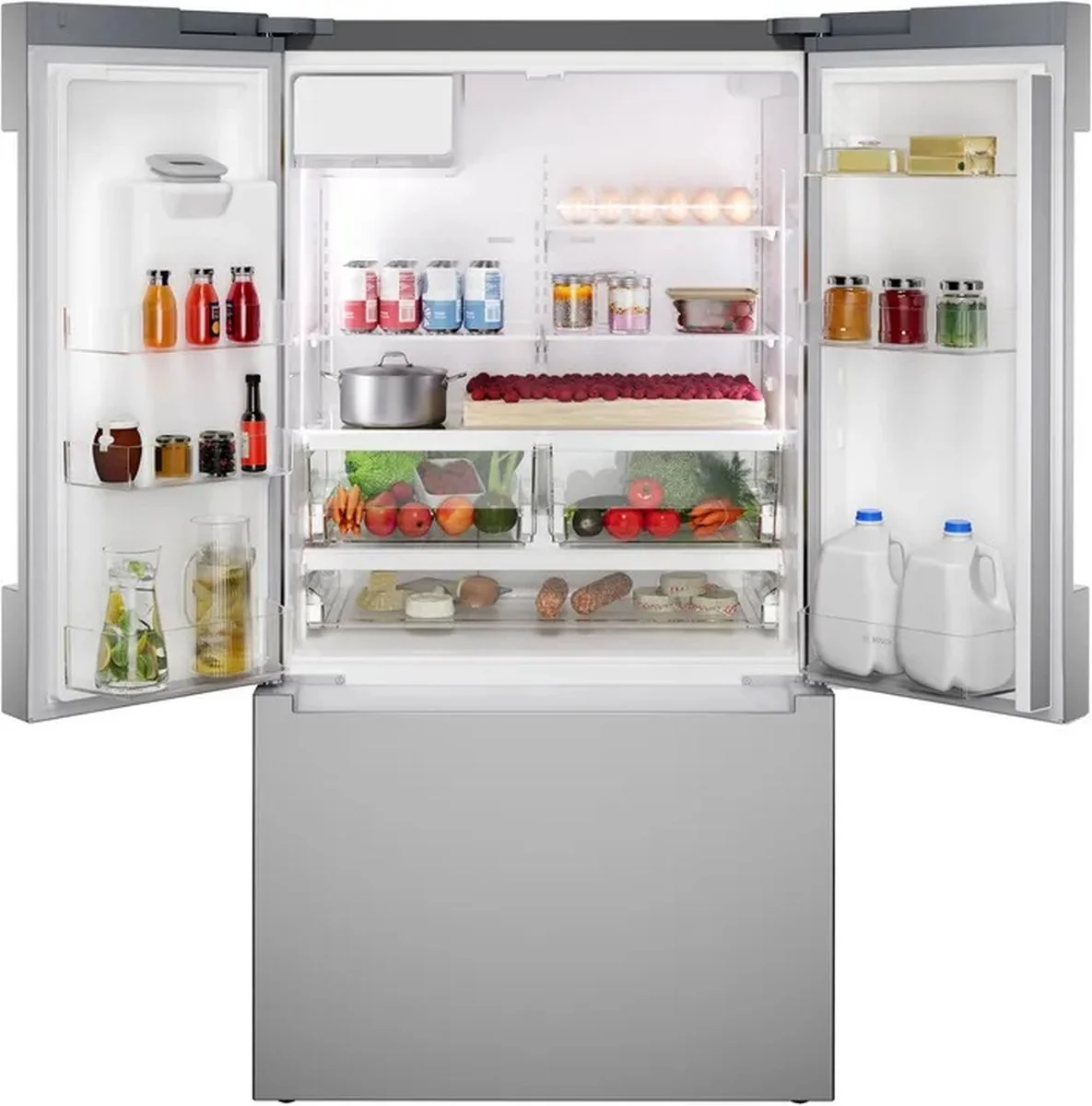
Water filtration runs through a built-in system with a replacement indicator light, so you know when to swap the filter instead of guessing by taste. Bosch’s water filter for this series (UltraClarityPro) is widely available from Bosch and third-party sellers, and the indicator triggers roughly every six months under typical household use. Some owners dislike the filtered taste and install an inline carbon stage ahead of the fridge, which is worth flagging if you’re sensitive to mineral flavor.
MultiAirFlow circulates cool air to keep shelves at even temperatures, and auto defrost handles frost management with no input from you. One honest note: this 100 Series model uses a single compressor. Bosch’s 500 and 800 Series step up to twin compressors and twin evaporators for better humidity and odor separation. You give that up at this price.
Smart features and finish
Home Connect Wi-Fi lets you check temperatures, adjust lighting, and run diagnostics from your phone. The diagnostics piece is the one that earns its keep: a service tech can pull fault codes remotely and arrive with the right part instead of scoping the problem on the first visit. If you’re comparing how this stacks up against the broader field, our roundup of the best smart refrigerators covers the connected options across brands.
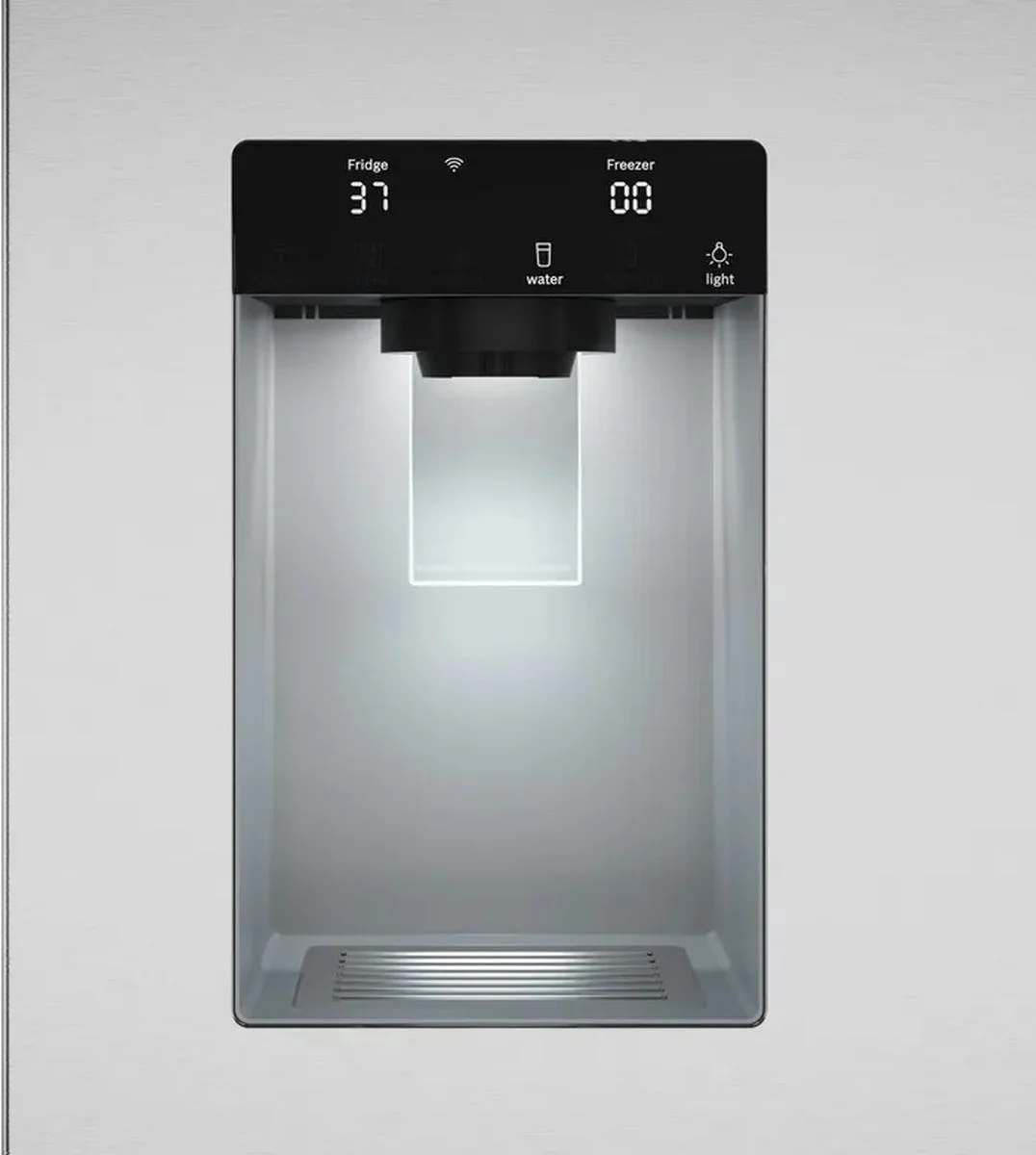
The anti-fingerprint stainless finish with integrated handles does a good job resisting smudges, which owners mention often. Other extras: ENERGY STAR certification (see the Energy Guide PDF on the product page for exact annual kWh), LED lighting in both compartments, Sabbath Mode, and a dispenser lock-out for households with small kids.
Bosch vs the Field
At $1,799, the Bosch is the cheapest model in this entire competitive set. Here’s the side-by-side at current pricing.
| Model | Price | Capacity (cu ft) | Main Advantage | Main Trade-off |
|---|---|---|---|---|
| Bosch B36CD10ENS | $1,799 | 21.6 | Quietest, premium brand at lowest price | Smallest capacity, single compressor |
| LG LRFXC2606S | $1,839 | 25.5 | Biggest interior, dual ice makers | Looser temperature control |
| Samsung RF23R6201SR | $1,899 | 22.6 | Twin Cooling Plus, flex pantry | Ice maker class-action history, louder |
| Frigidaire Gallery GRFC2353AF | $2,099 | 22.6 | Auto-close doors, dual ice | Less brand pedigree, newer platform |
| GE GYE22GYNFS | $2,197 | 22.1 | TwinChill dual evaporators, strong U.S. service | No Wi-Fi, $398 more |
| KitchenAid KRFC300ESS | $2,499 | 20.0 | Brand cachet, interior wine rack | Smallest capacity, no external dispenser, no Wi-Fi |
The honest read on each rival: LG is the capacity champion. If your household runs five or more people or does a big once-a-week grocery haul with a Costco run plus fresh produce, the extra 3.9 cu ft on the LG LRFXC2606S shows up immediately. Think a full gallon of milk, a rotisserie chicken, two half-gallons of juice, a produce drawer packed with greens, and still having room for leftovers. At 21.6 cu ft the Bosch handles that load for a two-to-four-person household without strain, but it tightens fast past four.
Samsung matches Bosch on cooling tech with Twin Cooling Plus but costs more, and owners report more noise. The GE GYE22GYNFS is also sold at Masters and brings true dual evaporators plus the best U.S. service network per Yale Appliance data, but it costs $398 more and drops Wi-Fi entirely. Frigidaire Gallery packs the most features for the price but carries a shorter reliability record on its current platform. KitchenAid is the weakest value of the group at $2,499 with no external water or ice.
What owners consistently praise
Reviewers and owners keep coming back to the same short list.
It runs quiet. Independent reviewer tests clock it between 38 and 42 dB, which beats most of the field. As one owner put it: “Runs at a low hum; good match for open living spaces.” If your kitchen opens to a living area, this matters.
The counter-depth fit surprises people. Shoppers expect tight interiors on counter-depth models. Owners push back on that. As one owner wrote: “Even though it is not as deep as traditional fridges, there is plenty of room for everything.” The shelf and door bin layout gets repeated praise, with the wide gallon door bins holding two large containers side by side on both door sets.
QuickIce Pro produces ice fast. Owners who care about ice throughput consistently call out the 8 lbs per day output. It’s marketed as the fastest in class, and in hosting or family-heavy use it keeps pace without needing a second run.
The finish holds up. The anti-fingerprint stainless resists smudges better than standard stainless. Parents of little kids call this out often.
Home Connect earns its keep. Remote temperature checks and built-in diagnostics get solid marks from owners who set up the app.
Owner ratings across major retailer sites currently range from 3.4 to 4.3 stars based on roughly two dozen verified reviews, which is a thin sample with mixed early signals. The sibling model B36FD10ENS, which shares the same compressor, controls, MultiAirFlow system, and Home Connect hardware, has a broader review base and trends more positive. We position that as a directional proxy, not a promise: it suggests the B36CD10ENS will trend similarly as its review count grows, but it isn’t a guarantee of identical performance.
What to watch for before you buy
A good deal is only good if it fits how you live. These are the trade-offs worth weighing honestly.
The capacity trade-off
At 21.6 cu ft, this Bosch is the smallest in its direct competitive bracket. LG has 3.9 cu ft more. Samsung and Frigidaire each have 1.0 cu ft more. For a two-to-four-person household, 21.6 cu ft is plenty. For a family of five or a household that does a big weekly stock-up, it will feel tight. If that’s you, the LG LRFXC2606S is the better fit even at $40 more.
Ice maker quirks
We hear the same ice maker feedback from owners across sites. The horizontal auger that pushes ice out is audibly noisy during drops. Cubes sitting at the front of the auger can melt and occasionally drip into the left door tray, especially if you open the door often. As one owner described it: “Ice maker will drip a little water into the left hand door trays on occasion.” It’s an annoyance, not a dealbreaker, and it’s worth knowing before the box shows up.
Water dispenser and shelf notes
A smaller number of owners flag sluggish water dispenser flow and occasional filter taste complaints. Flow tends to improve after a few filter cycles, but households that rely on the dispenser daily should know about it. We’ve also seen a handful of install-time reports of glass shelf bracket end pieces breaking during setup. It’s uncommon and Bosch ships replacements, but handle the shelves carefully when you unpack. A few owners also mention the doors need a firm push to fully seal, which typically settles after the gaskets relax in the first week.
Single compressor, not dual
The 100 Series uses one compressor. The Bosch 500 and 800 Series step up to twin-compressor, twin-evaporator designs for true humidity and odor isolation. For most households this is fine. If you store strong-smelling foods next to butter or fresh produce, you’ll notice the difference. Stepping up to a Bosch 500 Series counter-depth solves it but costs $500 to $1,000 more — our overview of the best Bosch fridges covers those higher-tier options if you want to compare.
Warranty and service reality
Coverage is 1-year parts and 1-year labor. That’s short for this class. Many competitors offer 1-year comprehensive with extended compressor coverage.
Bosch service scheduling also runs long in some regions. ConsumerAffairs threads and forum posts repeatedly describe multi-week waits for technician visits. Yale Appliance data pegs Bosch’s service rate at 10.7% in 2023, 11.6% in 2024, and 12.5% in 2025. Better than average, not the most reliable. If you rely on fast warranty response, the GE GYE22GYNFS with its stronger U.S. service network is worth the extra $398.
Who should buy the Bosch B36CD10ENS, and who should pass
Buy it if:
- You’re shopping premium-brand counter-depth French doors and want to stay under $2,000.
- Quiet operation matters for your open floor plan or kitchen-living combo.
- You value clean built-in aesthetics and the anti-fingerprint finish.
- 21.6 cu ft is enough for a two-to-four-person household.
- You’ll use Home Connect Wi-Fi for temperature checks and remote diagnostics.
Pass if:
- You need 25-plus cu ft for a large family; the LG LRFXC2606S is the better fit.
- Your household relies on the water dispenser heavily and flow speed matters.
- You need fast warranty service in your region.
- You need dual-compressor odor isolation; step up to the Bosch 500 or 800 Series.
- You need custom panel-ready or ADA-compliant models.
Where to grab the deal
The Bosch B36CD10ENS is in stock at Masters at $1,799, which is $1,000 below MSRP. If you’re cross-shopping and want a U.S. brand with dual evaporators and a stronger service network, the GE GYE22GYNFS is also on the site at $2,197.
At current pricing, the Bosch is the cheapest premium-brand counter-depth French door we can find. You trade raw capacity and dual-compressor isolation for quiet operation, clean looks, and honest savings. For a design-conscious household under five people that wants Bosch quality without the 500 or 800 Series markup, this is the one to move on at current pricing.