

Every manufacturer blog answering the gas vs induction cooktop question is selling you on whichever fuel their flagship uses that season. We sell both, across KitchenAid, Monogram, Thermador, and every premium brand in our catalog, so we have no reason to push you toward either answer. This article walks through the six trade-offs that actually matter, what each fuel does better on its honest merits, how the decision plays out at three price tiers we carry, and a decision framework that respects the fact that kitchens are different. No verdict. Just the real version.
Short answer if you only have 40 seconds: neither fuel wins universally. Induction is better at boil speed, precision simmering, cleanup, and kitchen air quality. Gas is better at high-flame techniques, cookware flexibility, power-outage resilience, and long-term repair cost. Pick on the cooking you actually do, not on the one-size verdict a brand blog wants to hand you.
Why Manufacturer Blogs Can’t Answer This Honestly
Search “gas or induction cooktop” and you get a page full of brand content. Jenn-Air pitches induction because their flagship line leans that way. Thermador has gas and induction product managers who both want content. Wolf’s editorial pushes the fuel the marketing team is promoting that quarter. None of these blogs are lying, exactly. They’re just structurally unable to tell you the other side, because the other side doesn’t make them any money.
We carry KitchenAid cooktops in both fuel types. We carry Monogram cooktops in both fuel types. We carry Thermador induction, and their gas story at the range level. If you walk in set on gas, we’ll sell you gas. If you walk in set on induction, we’ll sell you induction. The revenue math doesn’t care which one you pick, so the content doesn’t have to either.
That’s the lens readers should apply to any comparison on this topic, including ours. We’ll show our work, point to the mechanism behind each claim, and acknowledge when a trade-off is closer than it looks.
How Each Fuel Actually Works (Quick Primer)
Gas: Open flame under a grate
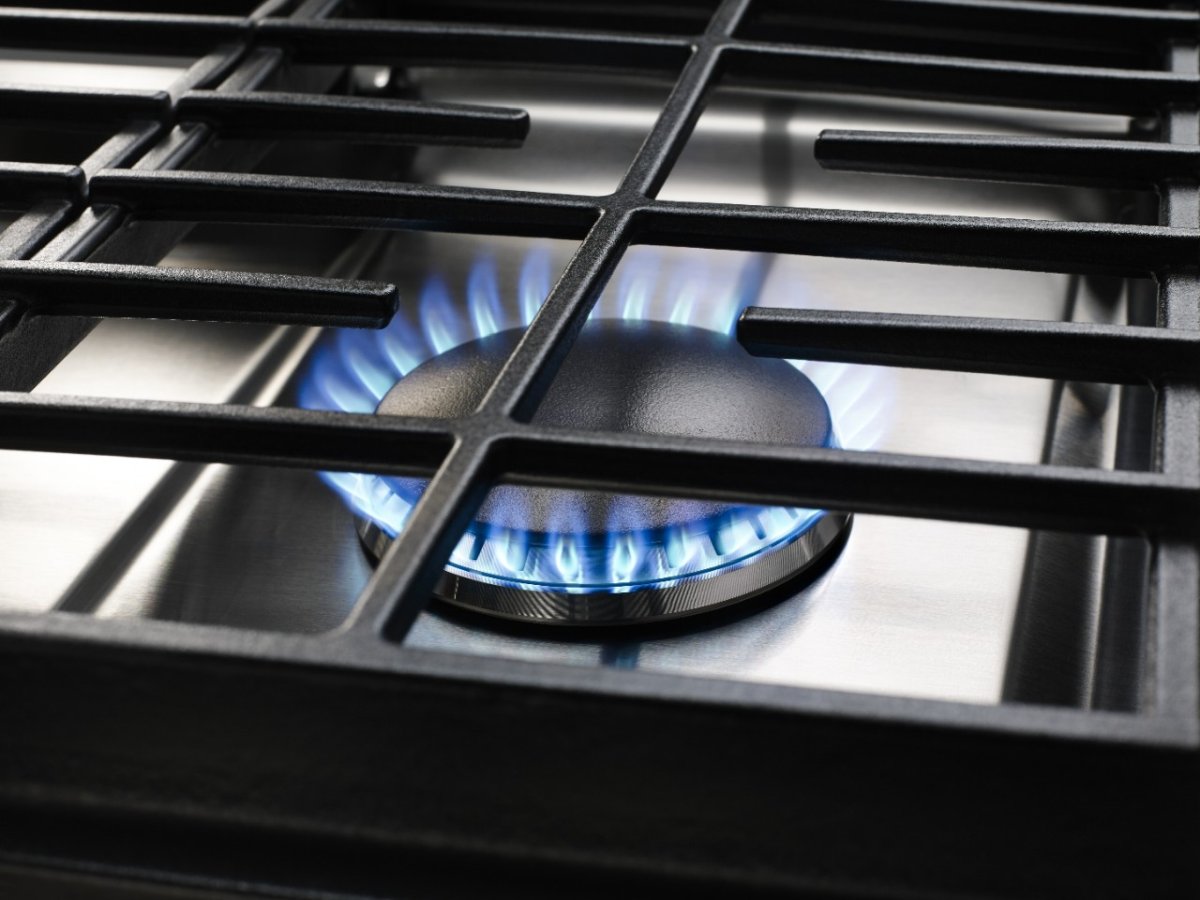
Natural gas or propane burns under a grate, and the heat goes up. The flame is visible, the control is visible, and the pan doesn’t need to sit perfectly flat to cook, since the heat source extends above the burner cap. What you see is what you get, which includes the combustion byproducts released into the room during cooking. That’s why every gas cooktop we sell pairs best with a proper external hood.
Induction: Magnetic coils, no flame
Induction works differently. Electromagnetic coils sit under a glass surface and induce an electrical current directly in the base of ferrous (magnetic) cookware. The pan heats up. The cooktop mostly doesn’t, apart from waste heat from the pan itself. There’s no flame, no combustion, and no dangerously hot surface lingering once you lift the pan off.
The catch is that induction requires cookware the coils can couple with. If a magnet sticks to the bottom of your pan, it works. If it doesn’t, it doesn’t. We cover the compatibility details below, and for readers who want the full walk-through of how the technology works, our Induction Cooktop Guide goes deeper on the physics and the practical implications.
The Six Trade-Offs That Actually Matter
The gas vs induction cooktop decision is really a cluster of smaller decisions. Here’s the scannable version. We’ll explain each row underneath.
| Dimension | Gas | Induction |
|---|---|---|
| Speed to boil | Solid | Faster in most kitchens |
| High-flame techniques (wok hei, char, flambé) | Wins outright | Can’t replicate |
| Low-end simmer precision | Good with a dedicated simmer burner | Wins outright |
| Cookware compatibility | Works with anything | Requires magnetic cookware |
| Daily cleanup | Grates and burner caps | Flat glass, faster wipe-down |
| Kitchen air quality | Combustion in the room | No combustion |
| Power outage behavior | Often lights with a match | Dead until power returns |
| Long-term repair cost | Mechanical parts, cheaper to fix | Sealed electronics, expensive |
Speed to boil. Induction transfers a larger share of its energy into the pan instead of heating the air around it, so a gallon of cold water hits a rolling boil faster. Not by a huge margin on small pots, but on stockpots and pasta water the difference shows up every time.
High-flame techniques. Wok hei, real charring, and controlled flambé all need flame contact above the pan line. Induction heats the pan bottom only. A flat-bottom induction wok cooks stir fry, but it doesn’t produce the smoky signature that open flame does. This isn’t a marketing gap. It’s a physics gap.
Low-end simmer. Holding a true simmer for a long braise or tempering chocolate is easier on induction because electronic control at the low end beats a mechanical gas valve. Gas cooktops with a dedicated simmer burner (like the KitchenAid’s 5,000 BTU Even-Heat unit or the 140F simmer on every Monogram burner) close the gap, but induction still wins the precision race.
Cookware compatibility. Gas cooks anything you put on it, including copper, pure aluminum, and non-magnetic stainless. Induction needs a magnetic base. The good news is that most modern stainless cookware already qualifies, and all cast iron qualifies. Test a pan in two seconds by sticking a fridge magnet to its base. If the magnet holds, the pan works.
Cleanup and air quality. Flat glass versus grates, burner caps, and drip surfaces. The difference is small per day and large over a year. The air-quality piece is a health consideration some buyers weight heavily, especially households with kids or anyone sensitive to indoor air.
Power outage and repair. Gas usually lights with a match when the ignition is out. Induction is dead without power. For repair, mechanical gas valves and igniters are cheaper to service than a sealed electronic board under a glass top. Not every induction failure is catastrophic, but the average repair bill skews higher.
What Gas Still Does Better (The Honest List)
Induction marketing has gotten loud in the last five years, and some of the claims don’t hold up to a cook who actually uses a wok. Here’s what gas still does that induction can’t match, or only matches at serious cost.
High-flame techniques. Wok hei, hard sears with flame licking up the pan walls, flambé for pan sauces, direct charring of peppers or tortillas on the grate. These all depend on an open flame that contacts food above the pan surface. Induction heats the pan base and only the pan base.
Visible control under pressure. When dinner is three burners deep and moving fast, a visible flame gives instant feedback a digital readout doesn’t. You see the flame height, you know the heat. No squinting at a touch panel.
Works with every pan you already own. Copper, aluminum, non-magnetic stainless, a cast-iron griddle your grandfather handed down, a pressure cooker with an unusual base. Gas doesn’t care. For cooks with a deep pan collection, the replacement cost of going induction adds real dollars the sticker price hides.
Power-outage resilience. If you cook through storms or live in an area with frequent outages, a gas burner you can light with a match is the difference between dinner and takeout.
Lower purchase price at every tier. We’ll show the numbers below. The short version: same brand, same width, gas is cheaper. That’s a real trade-off, not marketing noise.
Simpler, cheaper long-term repairs. Mechanical parts are serviceable by more technicians, and replacement igniters and valves cost less than replacement induction generators.
If you’ve landed on gas, our 36-inch gas cooktop roundup is the next read.
What Induction Actually Delivers (The Honest List)
Gas has its own marketing choir, and some of their claims also don’t hold up. Here’s where induction earns its premium on the honest merits.
Precision at the low end. Holding a 180F simmer for a six-hour braise, or a 120F hold for tempering chocolate, is legitimately easier on induction. Electronic temperature control beats mechanical valves once you drop below “low flame.” For the cook who does long slow work, the difference is daily. Our induction cooking guide covers the technique side if you’re new to it.
Cleanup. Flat glass wipes in 30 seconds. There are no grates to lift, no burner caps to scrub, no drip trays to pull and wash. Spills on induction hit a cooler surface and don’t carbonize the way they do on a gas burner. The compounding effect over a year of daily cooking is real.
Kitchen temperature and air quality. Induction dumps less waste heat into the room and produces no combustion byproducts. In a warm climate, in a tight open-plan kitchen, or in a household sensitive to indoor air, this matters.
Safer surface for households with kids, pets, or curtains nearby. No open flame, surface cools within minutes after the pan comes off, and most induction cooktops lock out when no pan is present. It’s not childproof, but it is a different risk profile.
Faster boil for weekday cooking. Pasta water, stockpots, big skillets preheating for a sear. Boil times drop noticeably, especially on larger vessels where gas loses heat around the pan walls.
Works with induction-ready cookware. Most modern stainless and all cast iron already qualifies. If your set doesn’t, a good starter set costs a few hundred dollars, and you can keep non-magnetic pieces for oven, prep, or gas-side use if you end up with a dual setup.
If induction is the direction, the best induction cooktops roundup is the next read.
What the Decision Looks Like at Three Price Tiers
Trade-off talk is abstract until you put real cooktops next to each other. Here’s what the decision looks like at the price points most of our customers shop.
Accessible Premium: The KitchenAid Pair
Same brand, same 36-inch width, same category. The cleanest same-brand cooktop comparison in our catalog.
The KitchenAid 36″ Gas Cooktop was a HOT BUY at $1,199 when we looked (down from a $1,599 MSRP; promotional pricing subject to change). Five sealed burners, cast-iron continuous grates, a 19,000 BTU multiflame burner that handles sear-to-simmer on a single element, and a 5,000 BTU Even-Heat simmer burner with a diffuser plate for low work. Made in the USA, LP-convertible out of the box, electronic spark ignition, knob control.
The KitchenAid 36″ Induction Cooktop runs $1,899 on a similar 25% discount off a $2,549 MSRP. Five induction zones under a stainless-framed glass surface, digital touch controls, control lock, 240V hookup. Same-family styling for kitchens already committed to KitchenAid stainless.

The $700 delta is real. That’s what flat-glass cleanup, induction-level simmer precision, and no open flame cost at this tier. Who picks the gas: the cook who already runs on natural gas, wants visible flame, and doesn’t want to re-check cookware. Who picks the induction: the cook prioritizing cleanup and low-end control, with 240V available at the cooktop location, and a pan collection that already passes the magnet test.
Luxury Tier: The Monogram Pair
Monogram is GE’s top brand, and a legitimate cross-shop against Thermador. Both cooktops here are floor models at the time of writing, which means pricing is sharper than usual but stock is limited.
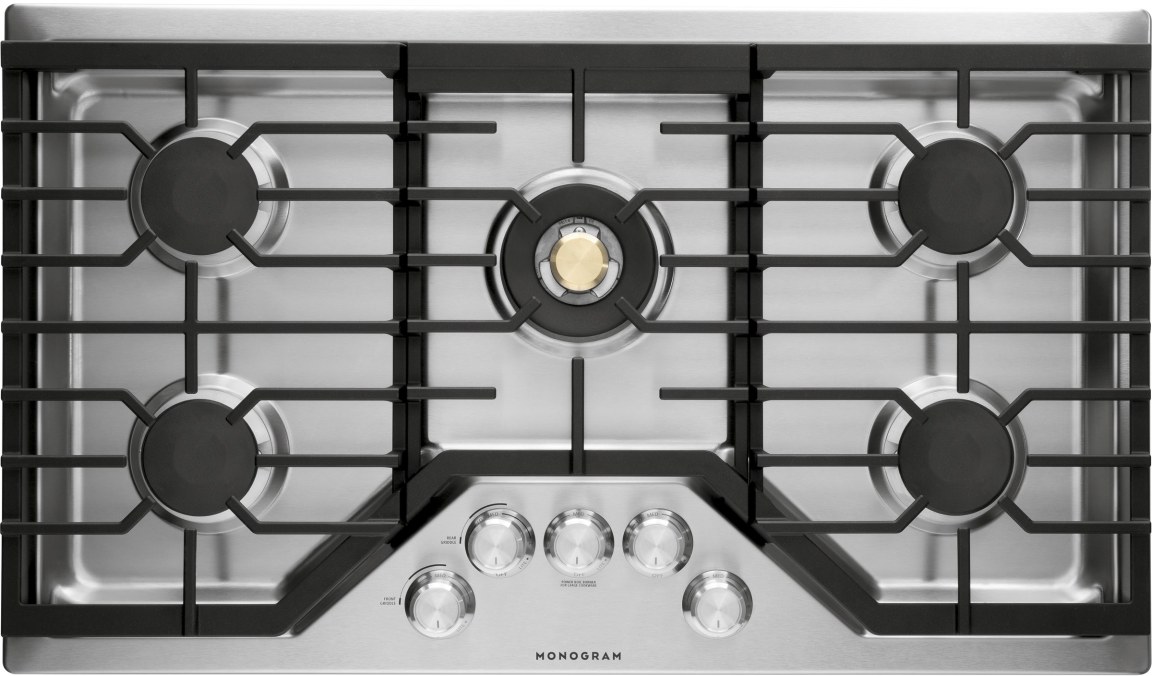
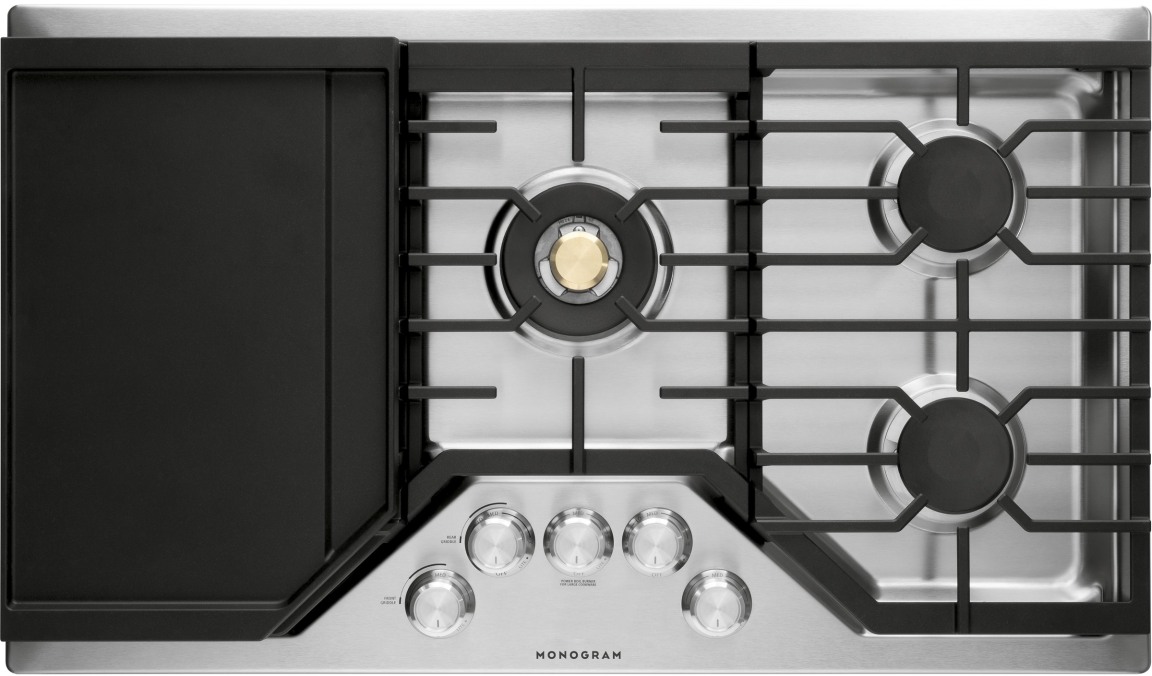
The Monogram 36″ Gas Cooktop lists at $1,497 (marked down from $2,500 MSRP, 40% off). Five sealed dual-flame stacked burners with a full 62,000 BTU total output, a 20,000 BTU tri-ring top burner, porcelain-enameled cast-iron continuous grates, a deep-recessed basin that contains spills, and precision knobs with illuminated sapphire glass inserts. Automatic re-ignition keeps the flame on if it gets accidentally extinguished. Every burner holds a true 140F simmer, not just one dedicated simmer burner.
The Monogram 36″ Induction Cooktop lists at $2,497 (marked down from $3,500 MSRP, 29% off). Five induction elements with two 3,000W tri-ring Power Boil elements, bridge/synchronized zones that combine into one large griddle-sized area, glide touch controls with 19 heat settings, Wi-Fi, pan presence sensor, and a Precision Temperature Control feature that maintains an exact degree setting from 100 to 500F with a compatible smart pan.
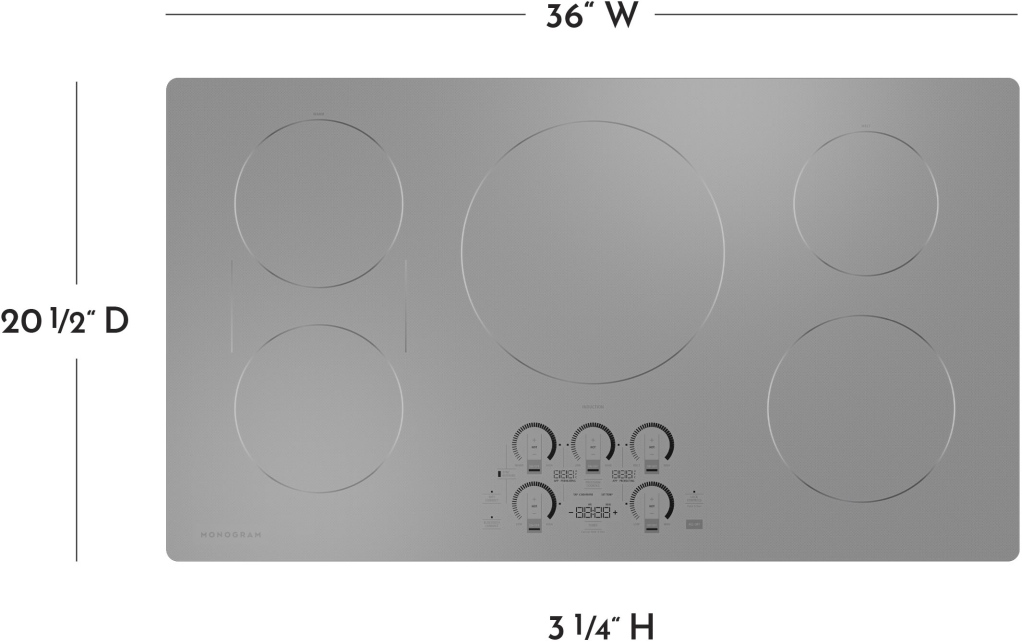
The $1,000 delta at this tier buys a heavier induction surface, bridge-zone flexibility, and smart-pan control that no gas cooktop can replicate. It also buys back the things induction takes away: no flame, no grates to lift. The decision at this tier is less about price and more about which cooking style you’re building the kitchen around.
Flagship Induction: Thermador Liberty
The Thermador Liberty 36″ Induction Cooktop sits at the top of the induction market as a reference point. $4,899 at full MSRP, no discount applied when we looked, which is how flagship Thermador usually goes.
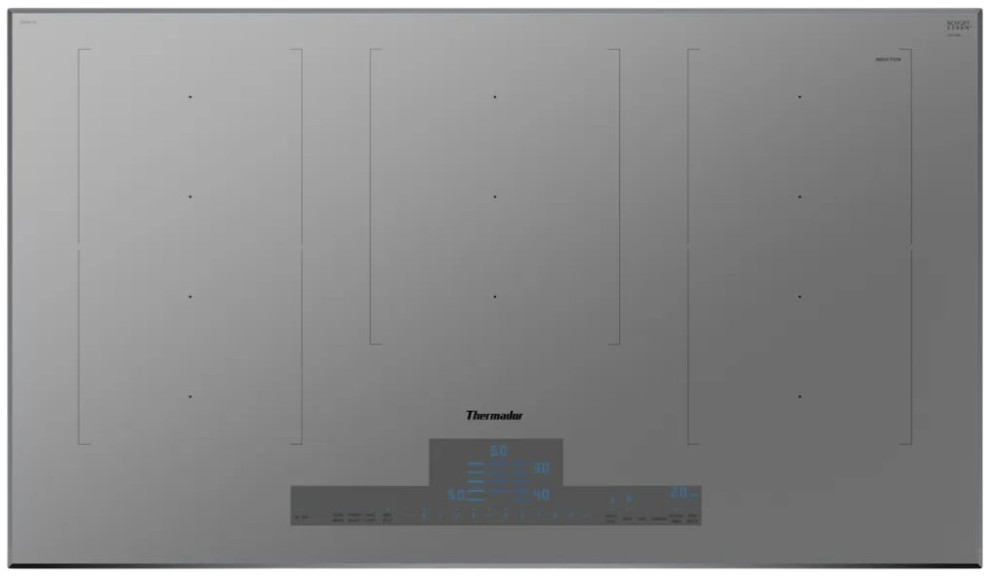
What the Liberty delivers over the Monogram induction: three extra-large Liberty cooking zones that accept any cookware size placed anywhere inside the zone (not fixed element circles), HeatShift for changing power by sliding the pan within the zone, MoveMode for transferring settings with the pan, a frameless glass design for flush installs, and Home Connect Wi-Fi with remote diagnostics that ties into the wider Thermador/Bosch/Gaggenau family of built-ins.
Worth being honest about the gas side here: Thermador’s gas story lives at the Pro Grand range level, not as a 36-inch cooktop. If you’re cross-shopping Thermador gas against Thermador induction, you’re comparing a $9,000+ pro range against this $4,899 cooktop, which isn’t an apples-to-apples comparison. That’s why we don’t force an awkward pair on the page. If you’re at this tier, you’re not choosing on price, you’re choosing on cooking philosophy.
Who Should Pick What: A Decision Framework
No verdict. Just the questions we ask customers when they’re stuck in the middle.
What do you cook most often? Wok work, high-char searing, and anything involving open flame above the pan line push hard toward gas. Long braises, weeknight volume cooking for a family, and precision sauces push toward induction.
Who else uses this stove? Kids learning to cook, older parents, or a partner nervous around flame all tilt the answer toward induction. The surface cools fast, there’s no open flame, and most models lock out when no pan is present.
Are you willing to learn a new technique? Induction has a real learning curve. Touch controls behave differently from knobs, heat response is faster than gas at the top end, and the lack of visual flame takes getting used to. If the answer is “no, I want my next cooktop to feel like my last one,” gas is the lower-friction choice.
What happens in a power outage? If you cook through outages, gas wins. If you have a whole-house generator or rarely lose power, it’s a non-factor. Worth checking before you commit.
Is this a remodel or a retrofit? A remodel lets you run whichever utility you want. A retrofit adds install cost on either side: a gas line if you don’t have one, a 240V circuit and panel capacity if you don’t. Neither is trivially swappable. Get an estimate from the electrician or the gas fitter before the appliance decision is final.
Cooktop or range? If your layout works better with a range than a cooktop plus wall oven, the top induction ranges category is worth a look. The fuel trade-offs transfer, but the install footprint and cost profile shift.
What We’d Do If It Were Our Kitchen
We’re not going to tell you there’s a universal answer to the gas vs induction cooktop question, because there isn’t. What we can tell you is how the decision actually splits across the kitchens we’ve seen.
The cook who runs a wok twice a week, sears hard, and learned on flame stays on gas. The family cook who does weeknight volume for a house full of kids, prioritizes cleanup, and wants the surface cold to the touch ten minutes after dinner goes induction. The cook who does a little of everything, has the budget, and wants the option of both often lands on a dual-fuel range or a setup that keeps a gas cooktop on one wall and a single induction burner elsewhere for the precision work.
What we won’t do is tell you induction is the future and gas is the past, or that gas is the only real way to cook and induction is for people who don’t know better. Both are marketing positions, and they’re both wrong often enough to be useless. Manufacturer blogs can’t say this because they’re selling you on one fuel. We sell both, so we don’t have to.
If you’ve narrowed the fuel question, the gas cooktop roundup and the induction cooktop roundup are the next reads. If you’re still torn, read the trade-off section above once more and answer the decision questions honestly. The right cooktop is the one that fits the cooking you actually do, not the one a brand blog told you to want.
Frequently Asked Questions
Is induction better than gas?
No universal winner. Induction is better at precision simmering, cleanup, boil speed, and indoor air quality. Gas is better at high-flame techniques like wok hei and charring, works with any cookware, and keeps working in a power outage. The right answer depends on the cooking you do, not on a one-size verdict.
Can you cook with a wok on induction?
A flat-bottom induction wok works on an induction cooktop and handles stir fry fine. A traditional round-bottom wok does not, because it can’t make contact with the magnetic surface. For authentic wok hei (that smoky, high-flame character), gas is still the right tool.
Is induction more expensive to install than gas?
It depends on what’s already in the wall. Induction needs a 240V, 40-50 amp circuit at the cooktop location. Gas needs a gas line and usually a 120V circuit for ignition. If you have one but not the other, the missing utility is the install cost. Neither is trivially swappable in a retrofit.
What happens to an induction cooktop in a power outage?
It stops working entirely. Gas cooktops can often be lit with a match when the electronic ignition is out, so cooking can continue. If outages are frequent where you live and you don’t have a whole-house generator, this is a real factor in the decision.
Does induction require special cookware?
It requires magnetic cookware. Most modern stainless steel and all cast iron already qualifies. A fridge magnet on the pan base tells you in two seconds whether a piece works. Copper, pure aluminum, and non-magnetic stainless don’t work on induction.
Is induction cheaper to run than gas?
Usually yes on energy efficiency, because induction transfers more of its energy into the pan instead of heating surrounding air. The actual utility-bill difference depends on local gas and electric rates, so the delta varies by region. It’s rarely the deciding factor.
Do professional chefs prefer gas or induction?
Restaurant line cooks still lean gas for flame visibility and wok work. Pastry kitchens and tasting-menu kitchens increasingly run induction for precision and a cooler working environment. Home kitchens aren’t restaurants, so pick on your cooking, not on a chef’s.